
After all, future dividends aren't guaranteed.
Companies can increase their dividends, maintain them, reduce them, or in rare cases eliminate them altogether.
So if the future is uncertain, how useful can a dividend income projection really be?
The answer is that projections aren't designed to predict the future with perfect precision. They're designed to help investors understand what future income is likely to look like based on the information available today.
For most dividend investors, that can be extremely valuable.
What Dividend Income Projections Actually Do
A dividend projection starts with information that is already known: how many shares you own, current dividend rates, payment schedules, and historical payment patterns.
Using that information, a projection estimates how much income your portfolio may generate over a future period—typically next month, next quarter, or the next 12 months.
The result is not a guarantee. It's an informed estimate.
Much like a weather forecast. No forecast is perfect. But most people still find forecasts useful when planning ahead.
Why Projections Are Often More Accurate Than Investors Expect
Many dividend-paying investments are remarkably consistent.
Large dividend stocks often maintain payouts for years. Many ETFs, REITs, closed-end funds, and other income investments follow relatively predictable payment schedules.
As a result, much of an income portfolio's future cash flow can often be estimated with reasonable confidence.
The farther into the future you project, the more uncertainty naturally exists. But for planning purposes, projections are often far more useful than having no forecast at all.
What Can Cause Projections to Change?
Dividend Increases
This is the change most investors hope for. When companies raise their dividends, projected income may increase.
Dividend Reductions
A company may decide to lower its payout. When that happens, future income estimates may decline.
Portfolio Changes
Buying or selling positions affects future income immediately.
Distribution Changes
Funds occasionally adjust their distributions based on portfolio performance, market conditions, or management decisions.
None of these changes mean the original projection was wrong. They simply mean new information became available.
The Real Value of Dividend Projections
Many investors focus on whether a projection will be perfectly accurate.
That's not actually the most important question.
Does the projection help me make better decisions?
For most retirees and dividend investors, the answer is yes.
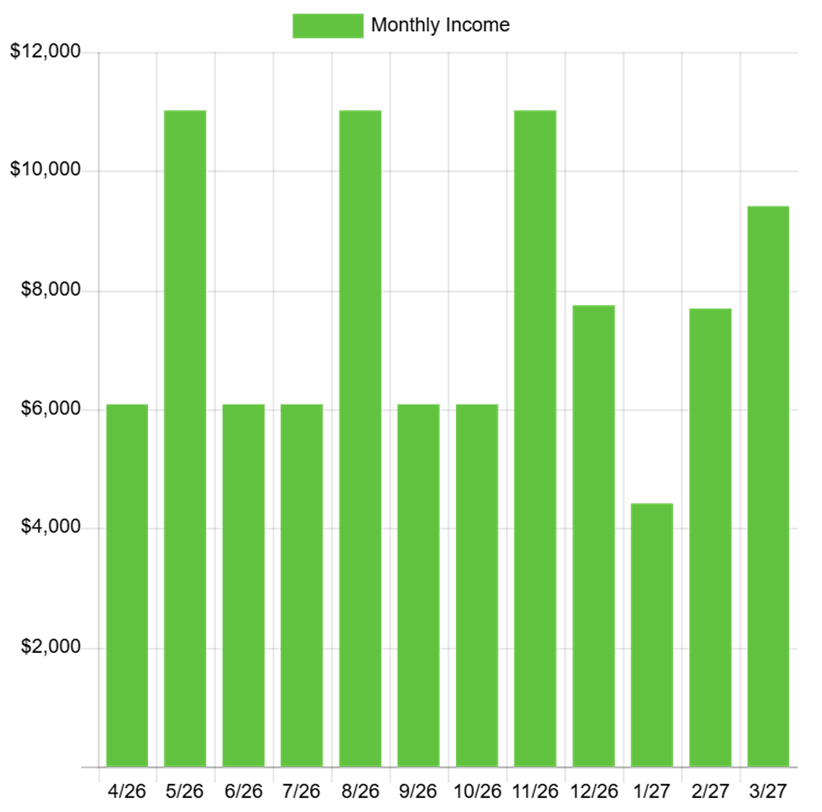
Good projections help investors understand which months are expected to produce income, which holdings generate the most cash flow, how income is distributed throughout the year, potential income gaps, and expected annual income levels.
Those insights remain useful even if future dividend payments change slightly over time.
Why Looking Backward Isn't Enough
Most brokerage dashboards do a good job showing what has already happened. They show previous dividend payments, historical income, and transaction history.
What they often don't provide is a clear picture of what's expected next.
For investors who rely on dividend income, that forward-looking perspective can be just as important as historical records.
The Goal Isn't Perfect Prediction
No dividend investor can predict the future with complete certainty. Markets change. Companies change. Portfolios change.
The purpose of dividend income projections is not perfection. The purpose is visibility.
A projection helps investors move from “I think my portfolio generates about this much income...” to “Based on the information available today, here's what income is expected to look like.”
That's a meaningful difference.
Key Takeaways
- Dividend income projections are estimates, not guarantees.
- Projections are based on currently available dividend and portfolio information.
- Dividend increases, reductions, and portfolio changes can affect future income.
- The primary value of projections is improved visibility and planning.
- Most investors benefit from having a reasonable forecast rather than no forecast at all.